A connectome describes the wiring of a nervous system. Building one requires anatomical data, reconstruction and verification. A computer model asks a related but different question: how can a specified set of cells and connections produce activity over time?
LOBSTER starts with the second question. Its foundation is a reduced model of the pyloric circuit, part of the stomatogastric nervous system studied in lobsters and crabs. The model evolves continuously; an interface translates that activity into actions inside an isolated browser.
A small circuit with a long research history
The stomatogastric nervous system has given researchers a tractable way to study rhythmic motor output, interactions between neurons and the effects of modulation. The pyloric circuit coordinates part of the digestive motor system. It is not a visual system or a model of an animal’s understanding.
Our implementation draws on the conductance-based model described by Prinz, Bucher and Marder, cell presets and topology imported from Open Source Brain, and a solver port checked against the mackelab implementation. The browser connection is an interface built for this project.
What this project represents. The running model is a reduced local circuit. The atlas documents its parameters and executable implementation.
Imagining the architecture
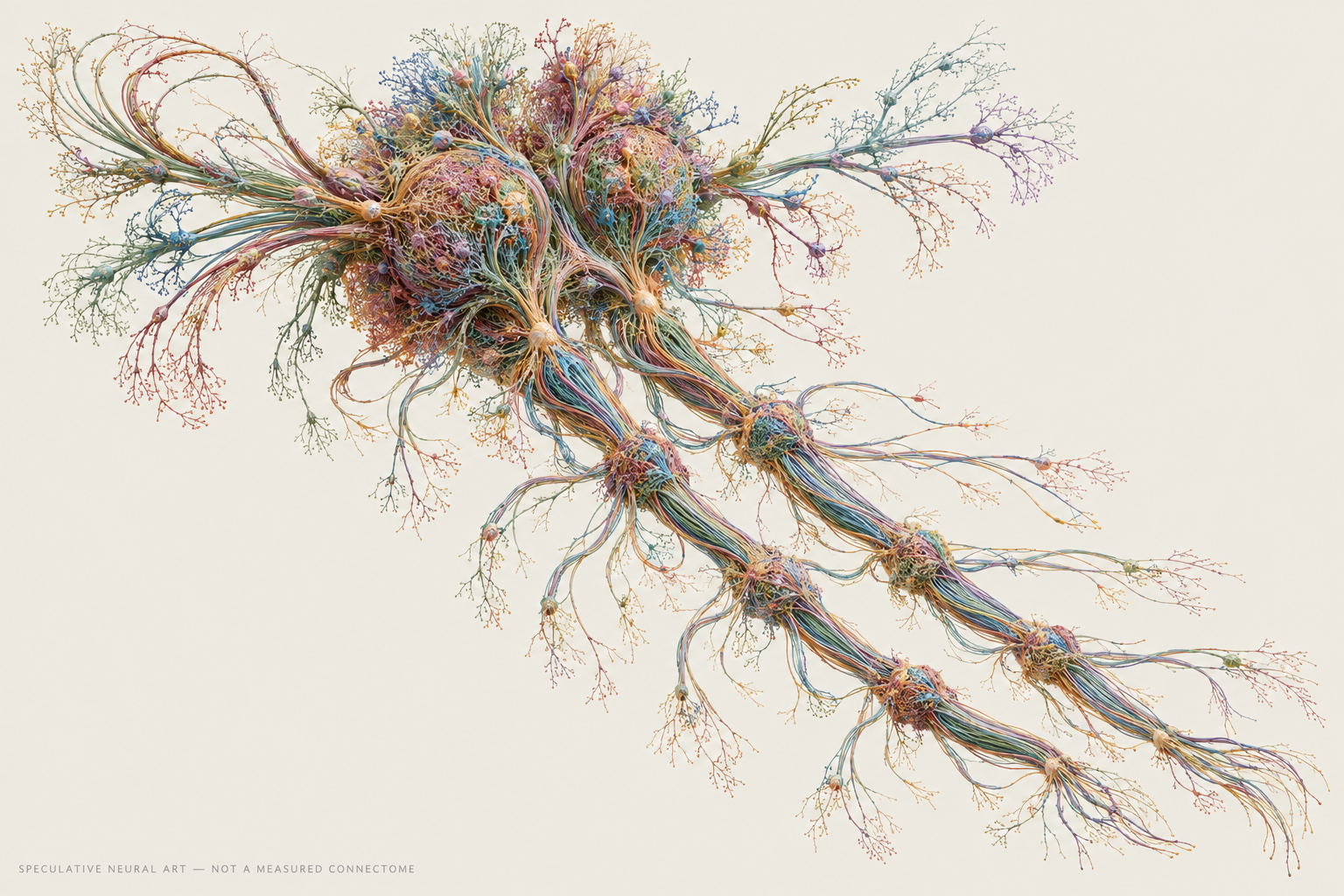
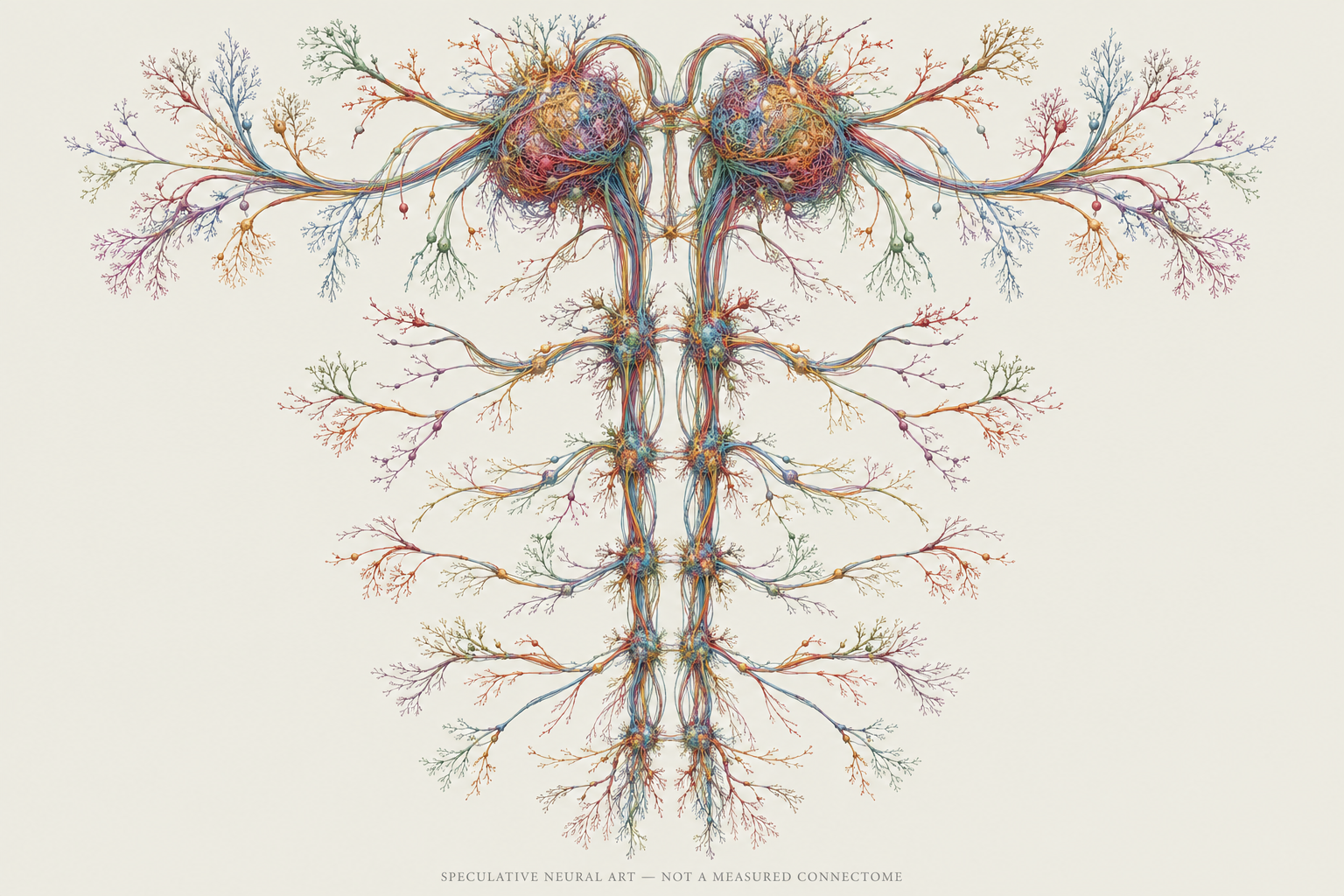
What might an intricate neural landscape look like in the visual language of our project? These two illustrations explore that question through branching fibres, paired structures and bundles of colour. The pair presents two independent artistic compositions.
Inside the circuit that actually runs
The live system has three model compartments: AB/PD, LP and PY. AB and PD share a lumped model voltage; PY represents a cell class. Seven inhibitory projections connect the compartments, including separate glutamatergic and cholinergic outputs from the pacemaker compartment.
PER COMPARTMENT
Each compartment includes eight membrane conductances and calcium dynamics. The model uses a 0.025 ms integration step. Cell conductance presets come from the published model lineage; synaptic strengths were selected here within the paper’s parameter range to produce an ordered baseline rhythm.
The original imported strengths and the active browser preset are both retained in the parameter file. The upstream NeuroML directory is marked work in progress, so the imported files are accompanied by a separately verified solver implementation.
From signal to action
A screenshot of the real browser is reduced to a small luminance grid. Quadrant darkness becomes three injected currents. The circuit evolves under those inputs, and its activity feeds a selector for visible article links.
An authored adapter guides the cursor to a selected link and clicks. It can also intervene at a dead end. These actions and interventions appear in the public journal. The model does not read or understand the page text, and the adapter should not be confused with a biological sensory or motor pathway.
The current environment is restricted to public English Wikipedia articles. Every viewer sees the same browser session, running on the dedicated server. If the engine or its connection stops, the site reports that the feed is offline.
What we verified—and what it tells us
The JavaScript solver was compared with the upstream implementation under zero and injected current. The recorded maximum voltage difference was approximately 3.45 × 10⁻⁹ mV across 606 sampled cell values.
The baseline checks found seven complete ordered AB/PD → LP → PY cycles after settling. Halving the integration step changed the mean baseline period by about 0.18%. Additional checks cover sensory-current input, synaptic disconnection and finite numerical behaviour.
These tests check numerical agreement and the circuit’s response under specified conditions. The measured validation report and reproduction archive make the scope of the checks inspectable.
What comes next
A richer model would need more than a denser picture. It would require identified cells, supported connectivity, parameters and validation appropriate to the biological question. The studies below provide context for local circuitry, morphology, ultrastructure and olfactory pathways; they are not a complete brain wiring dataset.
The practical direction for LOBSTER is to make each addition traceable: show where a parameter came from, what an interface contributes, and what a test actually establishes. The implemented circuit and its parameters remain open to inspection.
The research record
- Prinz, Bucher & Marder · 2004Similar network activity from disparate circuit parameters. The reduced model’s research lineage.
- Marder & Bucher · 2007Understanding Circuit Dynamics Using the Stomatogastric Nervous System of Lobsters and Crabs.
- Bucher, Johnson & Marder · 2007STG neuronal morphology and neuropil structure in Homarus americanus.
- E. A. Maynard · 1971Electron microscopy and local STG ultrastructure.
- Sullivan & Beltz · 2001Development and connectivity of olfactory pathways in Homarus americanus.
Credits & provenance
Model sources and their licences are included in the reproduction archive. This independent project is not affiliated with Google Research or the research groups cited here.